Beyond EBITDA: What Makes Profit Ethical?
Two businesses can produce the same profit - and create very different kinds of value.
Profit matters.
It keeps businesses alive. It rewards risk. It attracts capital. It funds innovation, creates employment and gives enterprises the ability to grow without permanent dependence on outside support.
So Ethical Profit is not an argument against profit.
It is an argument for understanding profit more completely.
Imagine two companies.
Both generate $100 million in profit.
Company A earns it by solving a genuine problem, treating employees fairly, building long-term supplier relationships, pricing transparently and creating something customers genuinely value.
Company B produces the same $100 million through aggressive supplier pressure, underpaid labour, misleading customers, regulatory arbitrage or environmental costs that somebody else will eventually have to bear.
The income statement may show the same number.
But are these really the same profit?
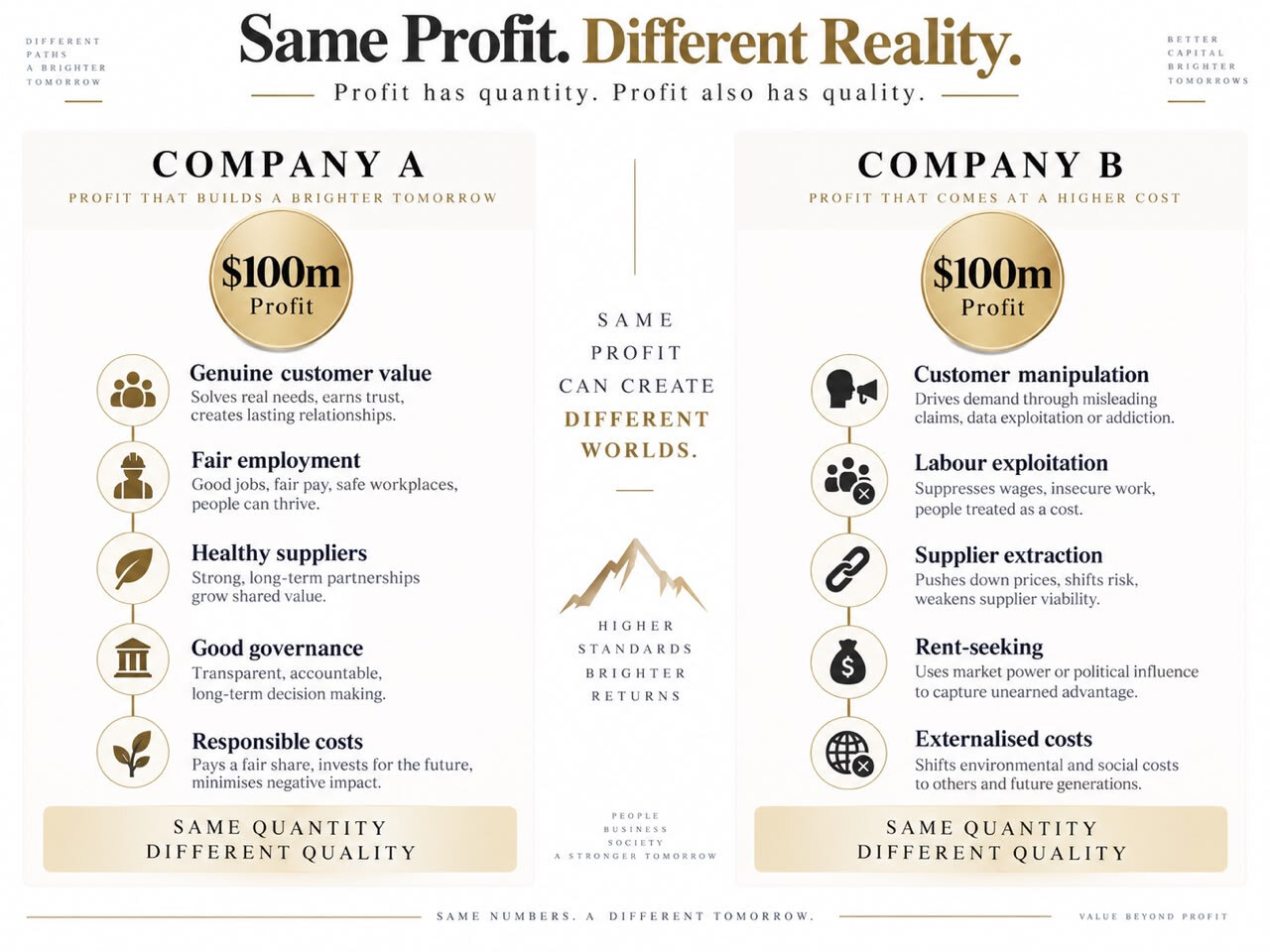
We believe they are not.
That distinction is what we call Ethical Profit.
Profit has quantity. It also has quality.
Investors already understand this principle.
A dollar of recurring earnings is not necessarily equivalent to a dollar generated through a one-off transaction.
Cash-backed earnings are different from accounting gains.
Sustainable revenue is different from temporary revenue.
Financial analysis therefore asks not only:
How much profit was produced?
It also asks:
How reliable is that profit?
Ethical Profit extends that thinking one step further.
It asks:
What had to happen in the world for this profit to be created?
Because every profit has a story behind it.
People worked.
Customers paid.
Suppliers participated.
Natural resources may have been consumed.
Communities may have been affected.
Management made choices.
Capital exercised power.
The final number tells us how much remained.
It does not tell us the whole story of how it got there.
The Ethical Profit question
Ethical Profit asks investors and business leaders to look behind the number.
CUSTOMERS
Did the company create genuine value?
Or did profitability depend upon confusion, addiction, manipulation, hidden charges or exploitation of vulnerability?
EMPLOYEES
Did productivity gains create shared opportunity?
Or did margins increase primarily because people with less bargaining power carried the burden?
SUPPLIERS
Did the enterprise build healthy commercial relationships?
Or did it simply transfer financial pressure down the supply chain?
GOVERNANCE
Were profits created through transparency, competence and fair competition?
Or through corruption, privileged access, rent-seeking and regulatory manipulation?
SOCIETY AND THE ENVIRONMENT
Did the company bear the reasonable costs created by its activities?
Or were some of those costs quietly transferred to communities, governments or future generations?
And finally:
CAPITAL
Once profits were created, what happened to them?
Were they reinvested productively?
Shared with shareholders?
Used to strengthen employees and communities?
Deployed into further innovation?
Or simply extracted as quickly as possible?
None of these questions makes profit illegitimate.
They make our understanding of profit more complete.
Ethical Profit is not the same as impact investing
This distinction matters.
A company does not need to solve poverty, climate change or another global challenge to generate Ethical Profit.
A restaurant can generate Ethical Profit.
A software company can.
A manufacturer can.
A property company can.
A logistics business can.
The question is not simply whether the company's purpose sounds noble.
The question is whether the business creates real value through relationships and practices we are prepared to stand behind.
A company with an inspiring mission can behave badly.
And an ordinary commercial enterprise can operate with extraordinary integrity.
Ethics belongs in the operating model, not merely in the marketing material.
Ethical does not mean unprofitable
There is another misconception worth confronting.
Ethical business should not mean weak business.
A company that continuously loses money eventually loses its ability to serve employees, customers, investors and society.
Financial strength matters.
The aspiration therefore should not be:
profit or ethics.
It should be:
financially excellent and ethically excellent.
- Strong margins.
- Good governance.
- Innovation.
- Competitive returns.
- Healthy relationships.
- Responsible consequences.
- Long-term resilience.
There will inevitably be trade-offs. Ethical judgment cannot be reduced to a perfect equation.
But refusing to measure something simply because it is difficult to measure does not make it irrelevant.
The investor's question changes
Traditional investing asks:
What return can this capital generate?
Ethical Capital asks:
What does this capital enable?
Ethical Profit then asks:
What kind of return are we actually earning?
Not merely:
What was the IRR?
But:
What had to happen for us to earn that IRR?
That question becomes especially important when capital has significant power.
Private equity owners influence incentives.
Venture investors influence growth expectations.
Family offices influence where generational wealth flows.
Boards influence management behaviour.
Capital is therefore rarely passive.
The demands made by capital can eventually travel through an entire organisation - from the boardroom to management, employees, suppliers, customers and communities.
Sometimes extraordinary value is created.
Sometimes value is simply extracted from somewhere less visible.
Knowing the difference matters.
From extraction to value creation
Perhaps the simplest way to think about Ethical Profit is this:
Extraction asks:
How much value can we take from this system?
Creation asks:
How much genuine value can this system produce - and how fairly can that value be shared?
The strongest businesses can do both:
create considerable economic value and earn attractive returns from it.
That is not anti-capitalism.
It is better capitalism.
And potentially, more durable capitalism.
A second dimension of performance
The financial world has become exceptionally sophisticated at measuring the quantity of returns.
- IRR.
- MOIC.
- EBITDA.
- Cash conversion.
- Margins.
- Growth.
- Enterprise value.
These measures matter.
We should keep them.
But perhaps the next evolution of capital is not to discard financial measurement.
It is to add another dimension.
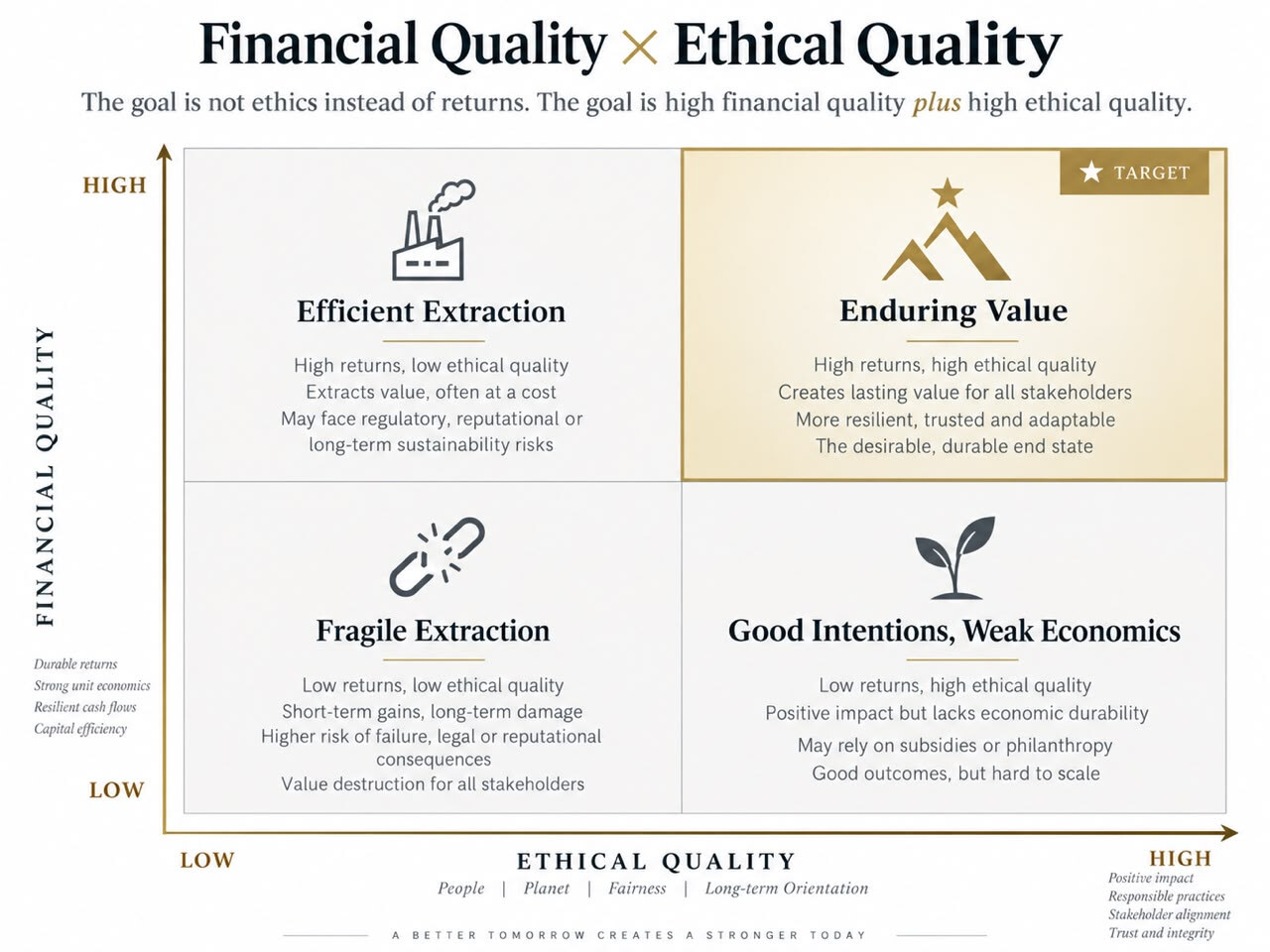
FINANCIAL QUALITY
How strong, sustainable and resilient are the earnings?
ETHICAL QUALITY
How were those earnings created, who benefited, who carried the costs, and what consequences followed?
The businesses worth building for the long horizon should aspire to both.
Profit is the beginning of another question
There is one final question that financial statements cannot answer.
Once wealth has been created:
How much is enough?
At what point does accumulation become stewardship?
What should remain invested?
What should be enjoyed?
What should be transferred to the next generation?
And what portion of accumulated wealth could become something larger than ourselves?
Those questions lead naturally into another idea we explore at Haramain Legacy:
abundance, sufficiency and enoughness.
Because the purpose of Ethical Capital is ultimately not merely to create more wealth.
It is to ask what wealth is for.
Ethical Capital and Ethical Profit describe Haramain Legacy's developing philosophy and framework. They are not industry standards, certifications or investment methodologies.